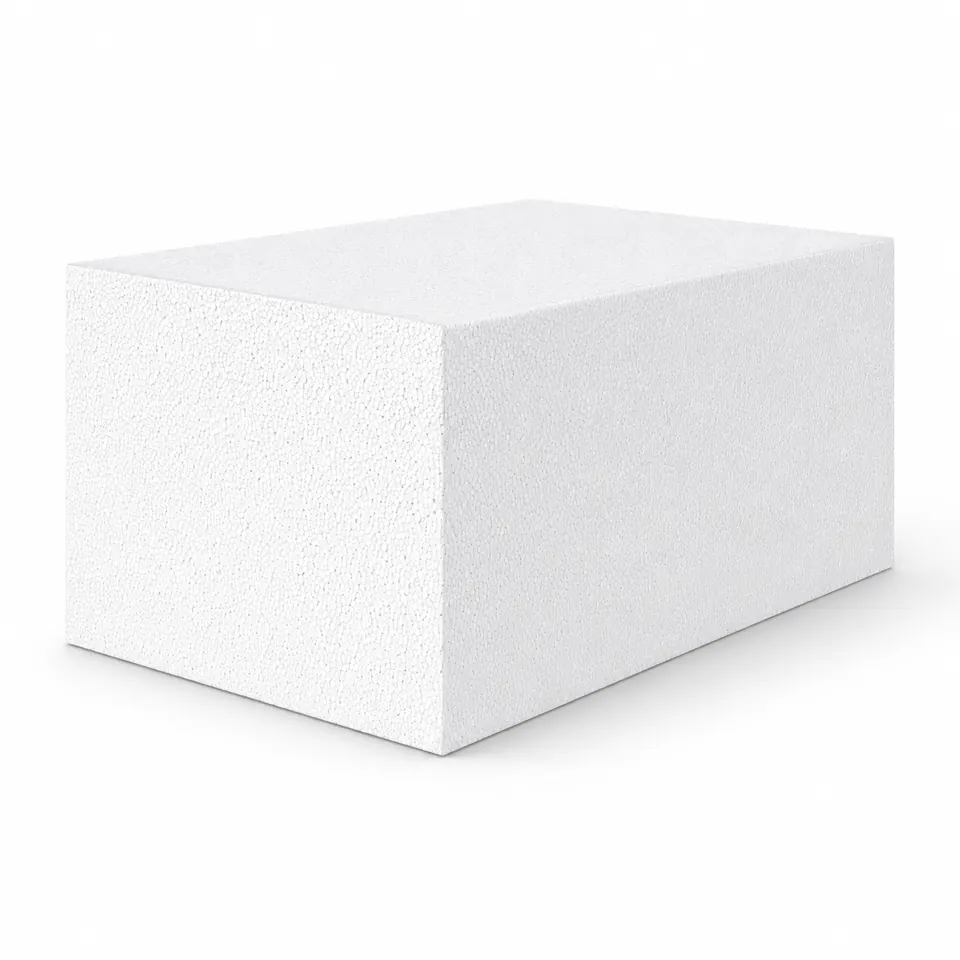
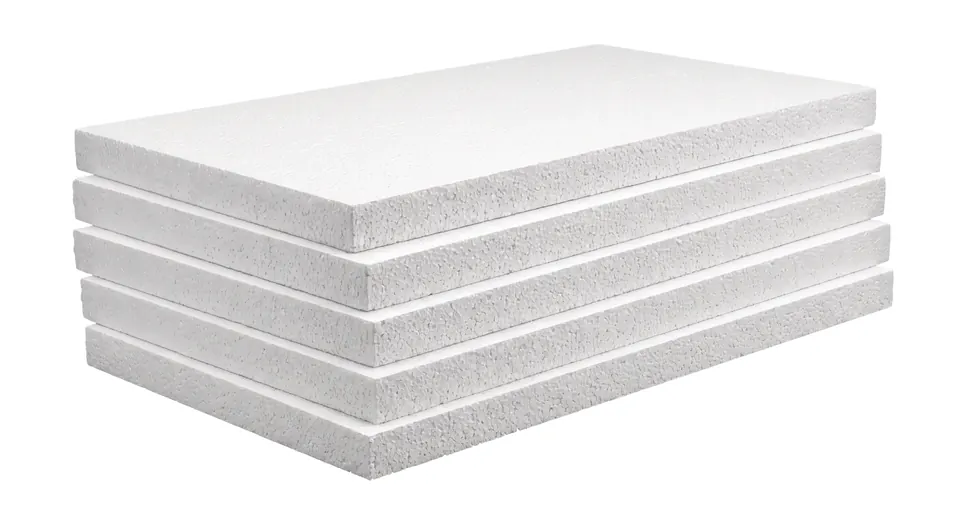
EPS (expanded polystyrene) and XPS (extruded polystyrene) are both rigid polystyrene foams, and both are used to insulate buildings. They are made in different ways, and that gives each one strengths for different jobs.
Aspen manufactures EPS, not XPS, so this guide explains where EPS is the better choice and where an XPS board is the usual specification.
How they are made
EPS starts as small polystyrene beads that contain a blowing agent. The beads are expanded with steam, then moulded and fused together into large blocks. The blocks are cut into sheets of any thickness, or into custom shapes. Under a close look you can see the fused beads on a cut surface.
XPS is made by melting polystyrene and pushing it through a die, where it foams into a continuous board with a smooth skin. XPS boards are usually coloured, for example blue, pink or green, depending on the brand.
Both foams have a closed-cell structure. The difference is that EPS has tiny channels between its fused beads, while XPS is one continuous foam.
Side by side
| Property | EPS | XPS |
|---|---|---|
| Thermal conductivity | Typically 0.032–0.038 W/m·K | Typically 0.028–0.034 W/m·K |
| Compressive strength | Roughly 70–250 kPa for common grades; higher densities are stronger | Usually from about 200–300 kPa, up to around 700 kPa |
| Water absorption (full immersion) | About 2–4% by volume, depending on density | Below 1% by volume |
| Sizes and shapes | Cut from large blocks to any thickness, size or profile | Standard board sizes and thicknesses |
| Cost | Usually lower for the same insulation value | Usually higher |
Figures are typical ranges published by manufacturers and vary by grade. Always check the datasheet for the product you are buying, and follow your project specification.
What the differences mean in practice
Insulation value
Grade for grade, XPS insulates slightly better per centimetre. EPS can match the same performance with a slightly thicker board, which is easy because EPS sheets are cut to whatever thickness you need.
Strength
Both are strong for their weight. EPS strength rises with density, and we produce EPS from 8 kg/m³ to 50 kg/m³, so a heavier grade can be chosen where the foam carries load. XPS reaches higher compressive strengths, which is why it is often specified under heavily loaded floors.
Water
This is the clearest difference. XPS absorbs very little water, so it is the usual choice where insulation stays wet or sits against damp ground, such as below the damp-proof membrane or in inverted roofs where the insulation sits on top of the waterproofing. In dry positions, such as inside walls, behind finishes or under a protected roof, the difference matters much less.
When EPS is the better choice
- Wall and roof insulation in dry positions, where it gives good insulation at a lower cost.
- Lightweight fill and void forming in construction, landscaping and road works, where large volumes are needed.
- Custom sizes and shapes: sheets in any thickness, and profiles, cornices and decorative pieces cut by CNC.
- Packaging, from insulated fish boxes to protective inserts.
When XPS is the usual choice
- Insulation in contact with wet ground or below the damp-proof membrane.
- Inverted roofs, where the insulation sits above the waterproofing.
- Floors that carry very high loads.
Fire
EPS and XPS are both combustible plastics. For buildings, both are made in flame-retardant grades and must be installed as the local fire code requires. We explain this in Fire retardant EPS: what it means and when you need it.
Choosing EPS for your project
If your drawings specify a thermal conductivity, density or compressive strength, send it to us with the sheet sizes and quantity. If not, tell us where the insulation goes and we will recommend a grade. Our buyer's guide lists what to include, and our sheets and blocks page has the sizes we produce.